Context-style adapters
Low-rank adapters inserted into the self-attention layers of the conditioning modules efficiently specialize the backbone for motion-style transfer while keeping content and style aligned.
 PickStyle

Context · Style · Motion
Video-to-Video Style Transfer
with Context-Style Adapters
Re-render any video in a style described by text — anime, Pixar, clay, LEGO — while the motion and content of the original stay intact.
1Pickford AI 2University of Toronto 3Vector Institute
* equal contribution
Abstract
PickStyle re-renders a video in a target style specified by a text prompt, while the context of the input — its content, layout, and motion — survives generation.
We address the task of video style transfer with diffusion models, where the goal is to preserve the context of an input video while rendering it in a target style specified by a text prompt. A major challenge is the lack of paired video data for supervision. We propose PickStyle, a video-to-video style transfer framework that augments pretrained video diffusion backbones with style adapters and benefits from paired still image data with source–style correspondences for training.
PickStyle inserts low-rank adapters into the self-attention layers of conditioning modules, enabling efficient specialization for motion–style transfer while maintaining strong alignment between video content and style. To bridge the gap between static image supervision and dynamic video, we construct synthetic training clips from paired images by applying shared augmentations that simulate camera motion, ensuring temporal priors are preserved.
In addition, we introduce Context–Style Classifier-Free Guidance (CS–CFG), a novel factorization of classifier-free guidance into independent text (style) and video (context) directions. CS–CFG ensures that context is preserved in generated video while the style is effectively transferred. Experiments across benchmarks show that our approach achieves temporally coherent, style-faithful, and content-preserving video translations, outperforming existing baselines both qualitatively and quantitatively.
Method
Low-rank context-style adapters specialize a pretrained video diffusion backbone; motion-augmented image pairs stand in for missing video supervision; factorized guidance steers style and context independently.
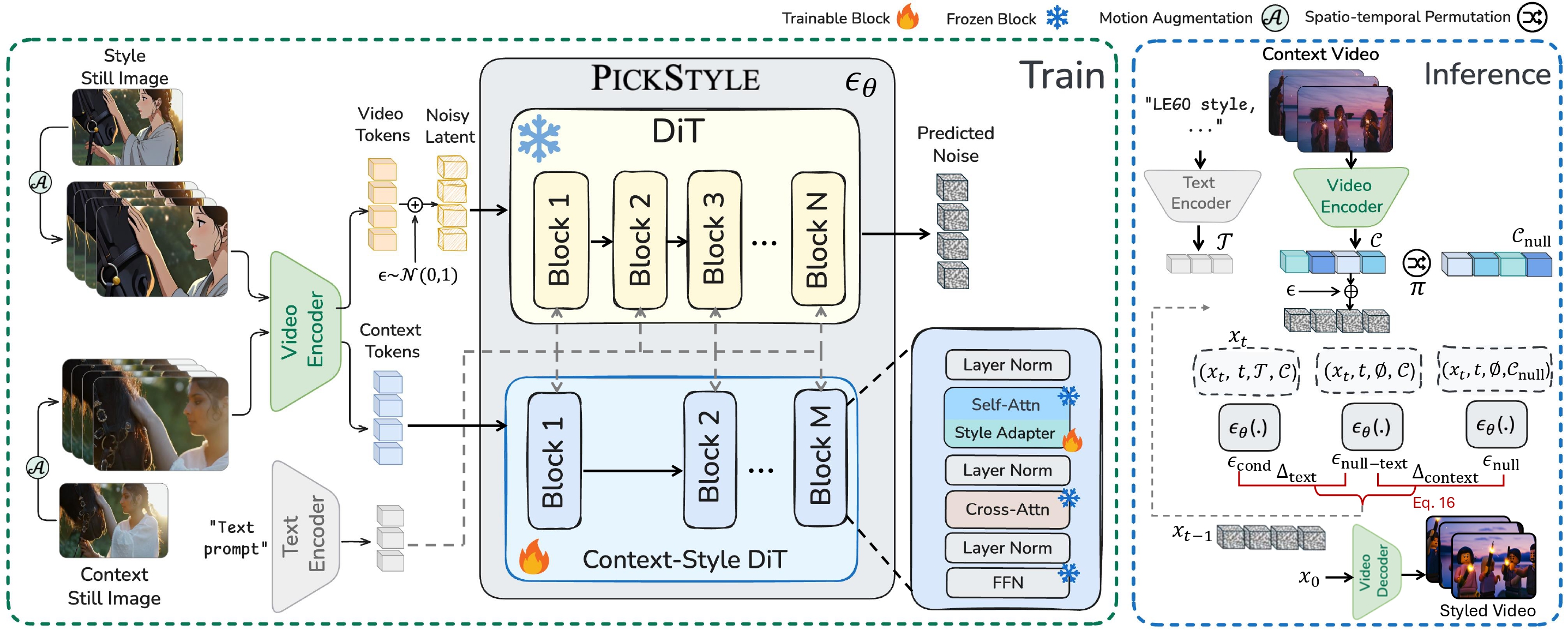
Low-rank adapters inserted into the self-attention layers of the conditioning modules efficiently specialize the backbone for motion-style transfer while keeping content and style aligned.
Synthetic training clips are built from paired still images with shared augmentations that simulate camera motion, preserving temporal priors without paired video supervision.
Classifier-free guidance is factorized into independent text (style) and video (context) directions, so the style transfers fully while the original context is preserved.
Results gallery
Style prompts spanning animation, film, and material aesthetics, applied across a range of source clips.
Citation
@article{mehraban2025pickstyle,
  title   = {PickStyle: Video-to-Video Style Transfer with Context-Style Adapters},
  author  = {Mehraban, Soroush and Adeli, Vida and Rommann, Jacob and Truskovskyi, Kyryl and Sanborn, Harrison and Taati, Babak and Clifford, Cole},
  journal = {European Conference on Computer Vision Workshops},
  year    = {2026}
}
Dive deeper